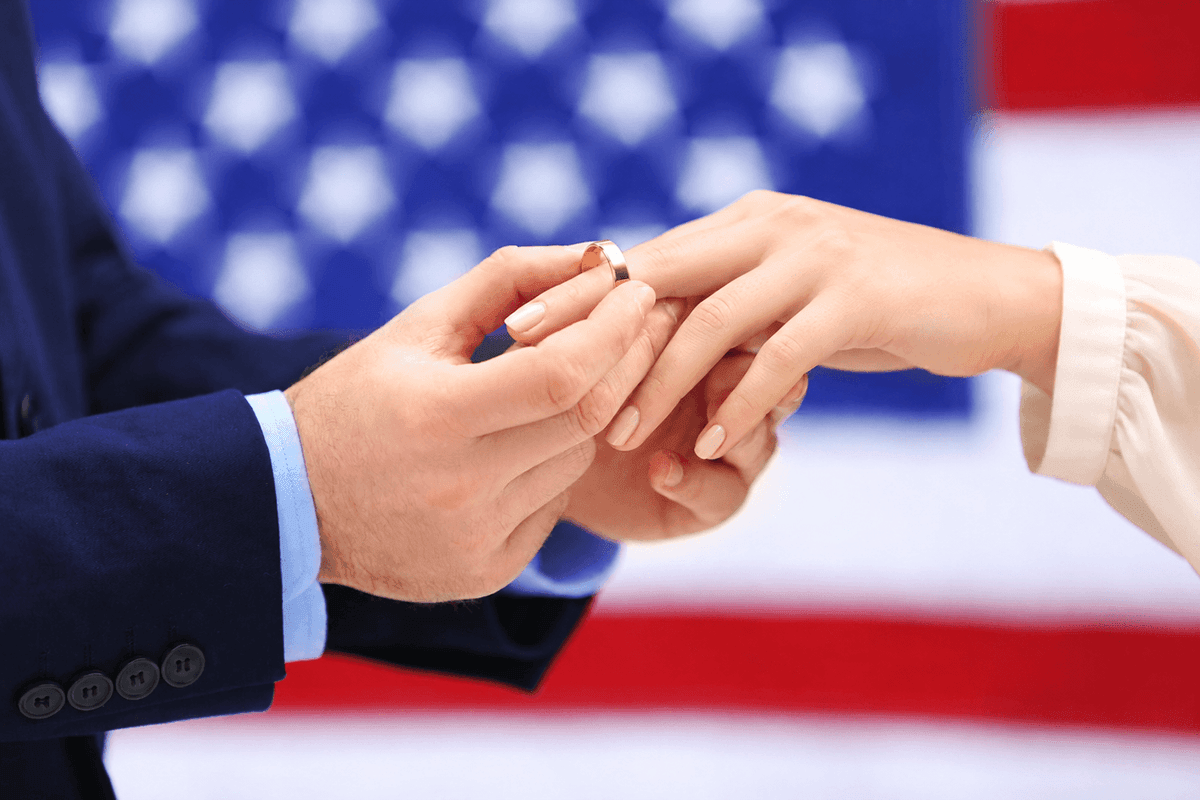
The K-1 is a special non-immigrant US visa for the foreign fiancé or fiancée of a US citizen. It is meant for couples who plan to marry in the United States and then arrange permanent residence for the foreign spouse.
The K-1 lets the foreign fiancé or fiancée enter the United States, after which the couple must marry within 90 days of entry. Once married, the foreign spouse can apply to adjust status and obtain a Green Card.
Who can get a K-1 visa
The main requirement is that the foreign fiancé or fiancée must be sponsored by a US citizen. A permanent resident of the United States who only holds a Green Card cannot use the K-1 to bring over a fiancé or fiancée. Both partners must be legally free to marry. If either has been married before, the lawful end of that marriage has to be proved — with a divorce certificate, for example, or a death certificate for the former spouse.
One more important requirement: the relationship must be real, not put together purely to obtain immigration status.
Do you have to meet in person
As a rule, the US citizen and their foreign fiancé or fiancée must have met in person within the two years before the petition is filed. There are limited exceptions to this rule. USCIS may consider an exception, for example, if meeting in person would cause the US citizen extreme hardship, or if meeting before marriage goes against particular cultural or religious traditions.
That is why, when preparing the documents, it helps to have proof of real contact and of meetings in person: photographs, correspondence, travel records, tickets and other material that shows the history of the relationship.
Where the K-1 process begins
The process does not begin at the embassy but with a petition filed in the United States. The US citizen files Form I-129F, Petition for Alien Fiancé(e) with USCIS. This form cannot be filed directly with a US embassy or consulate abroad. The petition sets out information about the US citizen and the foreign fiancé or fiancée, along with documents that prove the relationship and that the requirements are met.
USCIS then decides the petition. If it is approved, the case goes to the National Visa Center (NVC) and from there to the relevant US embassy or consulate.
Proving the relationship
One of the most important parts of the application is evidence that the relationship between the partners is genuine. Depending on the situation, this can be photographs together, a history of correspondence, call records, documents about trips taken together, plane tickets, records of meetings and other proof.
There is no set number of photographs or messages that automatically guarantees approval. What matters more is showing a consistent and credible history of the relationship.
The documents must reflect reality. Do not create correspondence, photographs or other material specially for the immigration case.
What happens once the I-129F is approved
Once the petition is approved, the case goes to the NVC. The centre gives the case a number and sends it to the US embassy or consulate that will handle the rest of the process. Once the instructions arrive, the foreign fiancé or fiancée starts preparing for the visa interview. The particular requirements can differ from country to country and from post to post.
So do read the instructions of the specific embassy or consulate where the interview will take place.
The DS-160 form
The K-1 uses the electronic form DS-160 — Online Nonimmigrant Visa Application. The applicant fills it in online and, after submitting it, must save and print the confirmation page with the barcode. Then follow the instructions of the relevant embassy or consulate to book the interview and pay the visa fee.
When filling in the DS-160 it is especially important to check personal details and information about education, work, travel and marital status carefully. Any material discrepancy between the form and other documents can lead to further questions.
What documents are needed
The exact list depends on the applicant's country of residence and on the instructions of the particular consulate. In general the interview may call for a passport, a birth certificate, documents ending any previous marriages, police certificates, a medical examination, photographs, proof of financial support and evidence of the relationship with the US citizen.
If documents are not in English, or not in the official language of the country where the case is being handled, translations may be required. The consulate may also ask for additional documents.
The medical examination
Before a K-1 is issued, the applicant has to have a medical examination with an authorised doctor. The embassy or consulate provides information on where the examination can be done. Do not simply go to any doctor for the immigration medical — you have to use an approved physician.
Vaccination is a separate matter: the State Department says that meeting the vaccination requirements is not mandatory for the issue of a K-1 in the same way as it is for some immigrant visas, but the corresponding requirements can arise later at the Green Card stage.
Financial support
During the visa process the consular officer may assess whether the applicant would become a financial burden on the state. Form I-134, Affidavit of Support can be used as proof of financial support if the consular officer asks for it. The requirements for the I-134 differ from those for Form I-864, which is used later when the Green Card is arranged.
Once the couple has married and the application to adjust status is filed, the US citizen will have to provide the appropriate form of financial sponsorship, usually the I-864.
The embassy interview
The interview is one of the key stages of the K-1 process. The consular officer may ask about the relationship, how you met, your meetings, family, work, previous travel and your plans after the move. The main thing is to answer honestly and consistently. There is no need for long rehearsed answers. It is better to explain the real history of the relationship calmly, in your own words.
If the relationship is genuine, it is important to know the basic facts of your future spouse's life well and to understand your plans for a life together.
How long a K-1 is valid
Once a K-1 has been issued, there are set deadlines for entering the United States. The State Department says the visa allows a single entry and that it may be valid for a maximum of six months from the date of issue, unless the particular visa is issued for a shorter period.
After entry the period that matters for the marriage begins: the US citizen and the foreign partner must marry within 90 days.
What to do after entering the United States
After entering on a K-1, the main next step is to marry the US citizen who sponsored the petition. Once married, the foreign spouse can file for Adjustment of Status — a change of status to permanent resident.
That is the point at which the separate Green Card process begins. The K-1 is not itself a Green Card and does not automatically turn the foreign fiancé or fiancée into a permanent resident.
What happens if you do not marry within 90 days
The 90-day rule is one of the key conditions of the K-1. If the marriage to the US citizen who filed the petition does not take place within that period, the person cannot simply carry on staying in the United States on the K-1 indefinitely.
In that situation you need to sort out your immigration status and what can be done next. Where the circumstances are complicated, it is better to go to a qualified immigration lawyer.
Can you work on a K-1
Whether you can work after entering on a K-1 depends on separate immigration procedures and on a work permit. So do not assume that the K-1 by itself gives an unlimited right to work in the United States. Once married and with an application to adjust status filed, the applicant can look at the routes to a work permit that the law provides. The rules that apply depend on the stage the case has reached.
Can you bring children
Eligible children of the foreign fiancé or fiancée may be able to obtain a K-2 visa. Children have separate visa applications, and each applicant has to meet the relevant requirements. The State Department also says that K-2 children must enter the United States before, or at the same time as, the K-1 holder parent. When preparing documents for children, check the requirements on their age, documents and deadlines in advance.
K-1, or marriage outside the United States?
Before starting, many couples weigh up two main options. The first is to get a K-1, come to the United States and marry there. The second is to register the marriage outside the United States and then apply for a spousal immigrant visa, for example the IR-1 or CR-1.
If a couple is already lawfully married, the K-1 is usually no longer the right category, since it is meant specifically for the fiancé or fiancée of a US citizen who plans to marry after entry.
The choice between them depends on the couple's own circumstances, where the partners live, the timing and their later immigration plans.
What a K-1 costs
The cost is made up of several things: the I-129F filing fee, the visa fee, the medical examination, obtaining the necessary certificates and documents, translations, photographs, travel to the interview, and after the marriage the costs of filing to adjust status.
Government fees change, so check the current amounts on the official USCIS and State Department websites before you file.
How long a K-1 takes
There is no universal processing time. How long it takes depends on how long the I-129F takes to decide, the transfer of the case to the NVC, the workload of the particular consulate, the availability of interviews and whether extra administrative processing is needed.
The State Department also notes that delays can arise if the applicant does not follow instructions or submits an incomplete set of documents.
So it is better to plan the move and the wedding with possible delays in mind, rather than going by the shortest times alone.
Common mistakes in a K-1 application
One common mistake is not preparing enough evidence that the relationship is real. It is not the number of photographs that counts but being able to back up the history of how you met and of your relationship consistently.
Errors in forms and documents are another problem. Dates, names, marital status or details of previous travel that do not match can prompt further questions.
Nor should the K-1 be confused with an ordinary tourist visa. The K-1 has a specific immigration purpose: entry to the United States to marry a US citizen and then arrange permanent residence.
The main points
The K-1 visa is for the foreign fiancés and fiancées of US citizens who plan to marry in the United States. The process starts with the US citizen filing Form I-129F; once the petition is approved the case passes through the NVC and the relevant American embassy or consulate.
Once the visa has been issued and the person has entered the United States, the couple must marry within 90 days. After that the foreign spouse can begin the separate process of obtaining permanent status.
Immigration rules change, and the particular requirements depend on the facts of the case and on the applicant's country of residence. Before filing, it is worth checking the current requirements on the official USCIS and US State Department websites.
End of the article.
All guides →